
Table of Contents
Disclaimer: This post may contain affiliate links, meaning I may earn a small commission at no extra cost to you if you purchase through them. I only recommend products I genuinely use and love.
Part of my job for the last fifteen years as the Conservation Manager at California Water Service and as a Consumer Packaged Goods expert has been telling the difference between a company that’s actually doing the work and a company that’s just very good at saying it is. So when I started digging into Burning Man’s sustainability claims, genuinely out of personal curiosity and because I wanted to to experience Burning Man, I found myself running it through the exact same filter I’d apply to any brand claiming to be “eco-friendly.” Here’s what held up, and what didn’t
Is Burning Man Sustainable: The Carbon Negative by 2030 Claim
This is the Burning Man Sustainable published goal, laid out in a 10-Year Environmental Sustainability Roadmap released back in 2019. To their credit, this isn’t vague marketing language, it’s a specific target with a specific date, and they publish annual progress updates against it. That’s more than most companies wearing a green logo ever do.
What I can’t verify from the outside is how close they actually are to hitting it. The event itself has been estimated to produce roughly 100,000 tons of carbon emissions across a single seven-day event, a genuinely enormous number for one week, driven heavily by travel to and from the festival, generator use, and the burns themselves. A public goal with an honest baseline is a real first step. These numbers would look very different if we could get an accurate read on the transport and travel to and from the festival.
Is Burning Man Sustainable: The Leave No Trace Claim
Widely marketed as the “largest Leave No Trace event in the world,” this is the claim I find most legitimately impressive, because it’s independently verified - not by Burning Man itself, but by the Bureau of Land Management. The BLM conducts a post-event inspection every year and requires the site to stay under one square foot of debris per acre to keep its land use permit. That’s an external check with real consequences attached, not a self-graded report card.
In 2023, after catastrophic rain and mud turned the event into a genuine crisis, the site still passed inspection, narrowly. That’s the kind of detail that makes a claim credible to me: it’s specific, it’s externally audited, and the organization is transparent when it barely squeaks by instead of hiding it.
Is Burning Man Sustainable: The Unresolved Problem: Lag Bolts
Here’s where I’ll give real credit for honesty. Burning Man’s own environmental restoration team has publicly named lag bolts, small metal screws used in shade structure and art construction, as the single worst, most persistent source of leftover debris, three years running. They didn’t bury this in a footnote. It’s in their public journal, by name, as the primary focus for improvement going into the next event. A brand willing to name its own worst offender, repeatedly, in public, is doing something most greenwashing brands never do.
Is Burning Man Sustainable: The Genuinely Gray Area Of The Burns Themselves
Setting fire to large wooden art installations, including the event’s namesake effigy, is central to the event’s identity and its emissions problem simultaneously. Organizers have started asking artists to be more “thoughtful and intentional” about what and how much gets burned, but this is guidance, not a hard rule, and it sits in real tension with an event built around impermanence and radical self-expression. I don’t think this one resolves cleanly, and I’d be skeptical of anyone who claims it does.
Is Burning Man Sustainable: The Social Responsibility Lens Assking Does Community Action Outweigh the Carbon Cost?
When evaluating “is Burning Man sustainable” through a social responsibility lens, we have to look at the big picture of the event. The event generates a massive carbon footprint through transport and large-scale art burns, which the organization has openly acknowledged in its 2030 carbon-negative roadmap. On the other hand, it’s the largest Leave No Trace event in the world and with this ethos and the Green Theme Camp Community, it has pioneered rigorous, community-led waste, solar, and composting infrastructures that rival professional eco-initiatives. Now, you will always find individuals who fall short, people who ignore the principles or treat the desert like a temporary playground. Perfection isn’t the reality here. But at the end of the day, I wanted to go because you can either stand on the sidelines or step into the arena to be part of the solution. When you witness tens of thousands of people channeling raw passion into protecting the earth, taking responsibility for the trash we create, focusing on relationships instead of monetary-driving incentives, and disconnecting from technology to focus inwards, it’s inspiring. It reminds me that culture is built by the choices we make when no one is watching. The value of community-led action, deep accountability, and shared culture provide the social framework needed to help protect this planet. When I think about true sustainability it reminds me that all big changes require teamwork, community building, and human action.
Is Burning Man Sustainable: Social Responsibility In Action
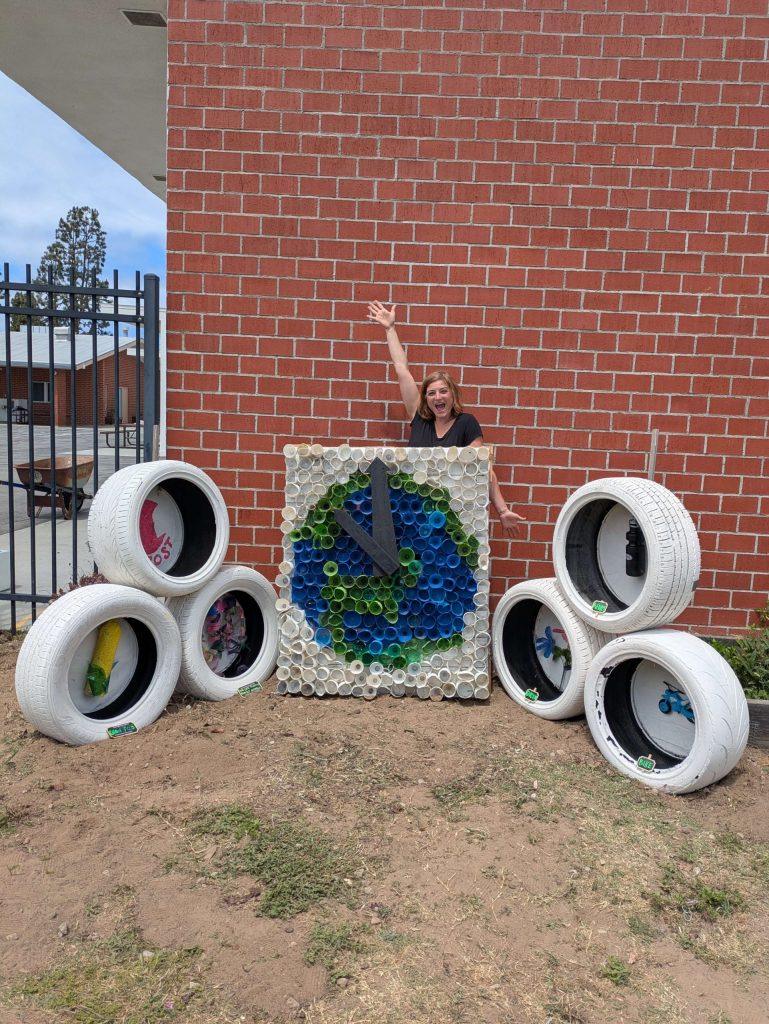
I have a true example in my own life with my small sample size of one. After going to Burning Man, I was so inspired by art installations, passion, and love for protecting our earth that I came back after Burning Man and built my own art installation. I was so inspired by the question of “is Burning Man Sustainable?” that I titled the installation “TikTok Earth” and it was revealed at the Venice After-Burn event and is now up at Alta Vista Elementary School in Redondo Beach. The theme is around minimizing the use of plastic in our everyday lives. There were over 100 used plastic bottles to create the shape of the earth and next to the earth on each side there are three stacked tires each representing top key ways we can fight climate change (Composting, growing our own food, protecting nature and creatures, Bike more drive less, bring your reusable water, and plant native flowers). All of these changes we can make are some of the highest impact things any single person can do. When we remember to each do a little bit more of each of these things we can collectively make a massive difference. This is what was inspiring to me at Burning Man and this is what I wanted to inspire by making this art piece. It was a community project with our neighborhood community that I want children to remember and inspire future generations. THIS is Burning Man sustainable action happening in realtime.

5 Surprising Facts Behind the Desert City’s Footprint
- The 90% Travel Rule: Up to 90% of Burning Man’s total macroeconomic carbon footprint (estimated at 100,000 metric tons) comes entirely from getting tens of thousands of participants to and from the remote Nevada desert via cars, RVs, and flights, long before a single generator is even turned on.
- Generators Dominate On-Playa Power: According to official Black Rock City greenhouse gas inventories, generators and heating fuel make up roughly 59% of direct on-site fossil fuel emissions, running continuously in the extreme heat for theme camps, sound systems, and RV air conditioning.
- Mutant Vehicles Are a Small Slice: Despite their massive visual presence, mutant art cars account for less than 3% of the event’s direct operational emissions, while large-scale art burns and the Man burn combined make up about 9% of the on-playa footprint.
- The Strict “One Square Foot” Rule: The Bureau of Land Management (BLM) forces the event to stay under one square foot of debris per acre post-event, or organizers lose their federal land-use permit, making it one of the few large events with an externally audited cleanup threshold.
- Nearly 50% of Burning Man Project’s operational fossil fuel emissions: Approximately 50% of Burning Man operational fossil fuel emissions were avoided: or displaced through solar, batteries, and renewable fuels in Black Rock City 2025.
Overall, the biggest takeaway from these numbers is that we need to significantly reduce our travel carbon footprint and lower on-playa generator dependence. To address the massive travel footprint, the Burning Man Project can implement targeted transit logistics and mass transit incentives:
- Centralized Gear-Hauling Co-ops: Because many participants drive trucks filled with heavy infrastructure out of distrust for shared logistics, setting up regional containerized freight hubs allows participants to ship heavy gear ahead via centralized freight trucks, replacing thousands of individual passenger vehicles on the highway.
- Expanding the Burner Express: The organization can significantly scale up the Burner Express bus and flight networks. If a much higher percentage of the 75,000 participants take organized mass transit from Reno or West Coast hubs instead of single-occupancy vehicles or rented RVs, the overall vehicle count drops exponentially.
- Geofenced Carpooling & High-Occupancy Lotteries: Implementing strict vehicle pass availability tied directly to vehicle occupancy, such as heavily pricing single-occupant vehicle passes while offering prime camping placement or early access to cars carrying four or more people, dramatically encourages efficient travel.
To tackle the second major challenge, the on-playa fossil fuel footprint driven by power, the organization and theme camps have powerful avenues for improvement:
- Centralized Solar & Battery Micro-Grids: Rather than every theme camp running its own noisy diesel generator, large-scale temporary energy storage grids utilizing massive battery banks and solar arrays can be deployed to power multi-camp sectors.
- Transitioning to Renewable Diesel (R99): For heavy machinery, art transport, and remaining generators that cannot instantly run on solar, the event can scale the use of R99 renewable diesel and cleaner alternatives like renewable propane to instantly drop net carbon output.
- The “Renewables for Artists” (RAT) Team: A volunteer collective can actively mentor and help artists design low-voltage solar or alternative energy setups for massive art pieces so they no longer rely on dedicated generator trailers.
- Fuel-Delivery Cooperatives: Establishing strict decibel and fuel-efficiency standards for permitted generators, coupled with centralized fuel-delivery co-ops, cuts down on thousands of individual support trucks driving back and forth to Gerlach, instantly scaling down the event’s direct fossil fuel footprint.
The Verdict: Is Burning Man Sustainable?
My honest opinion, using the same lens I’d use on food items, mattress brands, or a cleaning product claiming to be non-toxic: it’s a large, high-impact event that has built real, externally verified accountability into how it measures its worst behavior, publishes a specific and dated goal, and is transparent about the areas it hasn’t solved yet. This combination of real targets, real measurements, and public honesty about what’s still broken, is a great way to look at sustainability claims. It doesn’t matter if it’s a 70,000-person desert city or a single product on a store shelf. It’s rare. It’s also not the same thing as “solved.”
In order to look at Burning Man with a sustainability lens you need to look at the big picture of the event. On one hand, the event generates a massive carbon footprint through transport and large-scale art burns, which the organization has openly acknowledged in its 2030 carbon-negative roadmap. On the other hand, it’s the largest Leave No Trace event in the world and with this ethos and the Green Theme Camp Community Burning Man has pioneered rigorous, community-led waste, solar, and composting infrastructures that rival professional eco-initiatives. Now don’t get me wrong, you will always find individuals who fall short, people who ignore the principles, abandon their gear, or treat the desert like a temporary playground rather than a fragile ecosystem. Perfection isn’t the reality here. But at the end of the day, I wanted to go to Burning Man because you can either stand on the sidelines complaining about the state of the world, or you can step into the arena and decide to be part of the solution. When you witness tens of thousands of people channeling raw passion into protecting the earth, taking responsibility for the trash we create, focusing on relationships instead of monetary-driving incentives, and disconnecting from technology to focus inwards, it’s nothing short of inspiring. It reminds me that culture isn’t always handed down to us, it’s built by the choices we make when no one is watching. So long story short, I believe the value of community-led action, deep accountability, and shared culture provide the inspiration that’s needed to help in the largest picture of protecting this planet. We need teamwork, community building, and action for true sustainability and to help the human race.
Burning Man will never be a fully green event, whenever you bring thousands of people into the middle of a desert on diesel and jet fuel that is kind of ruled out from the start. But perfection isn’t the point here. The real value of the playa isn’t what happens for one week in August; it’s what people bring home. When you spend a week practicing radical accountability, hauling out every scrap of gray water, obsessing over micro-trash, and leaving the ground cleaner than you found it, it changes how you look at your own backyard. You don’t need a desert temporary city to start applying those standards.So what are your thoughts to the question, “Is Burning Man Sustainable”? Comment below on what you think and what can be improved.
Trying to create your own zero-waste habits?
If you’re building your own zero-waste habits at home, I’ve written a full walkthrough of the kitchen and bathroom swaps that actually reduced our household trash to less than one bag a week, you can find that in my Zero Waste Living Guide for Small Spaces article. If composting feels intimidating, the Bokashi method is the exact “no backyard required” system that made it click for me. Managing food waste in a place with zero municipal trash infrastructure or municipal composting is one of the ultimate tests of radical self-reliance. On the playa, traditional aerobic composting is nearly impossible, it takes up too much space, attracts pests in the desert heat, and requires moisture levels that don’t survive a dry lakebed.
That is exactly why camp-level composting can include Bokashi composting, an anaerobic fermentation method that fits seamlessly into a mobile, small-space setup. Unlike traditional composting that relies on oxygen and worms, Bokashi uses inoculated bran (loaded with effective microorganisms) to pickle and ferment food scraps, including citrus, meat, and dairy that would ruin a traditional bin.
In a van, an apartment, or a remote desert camp, a sealed Bokashi bucket takes up minimal floor space, produces zero odor, and breaks down food scraps into a pre-compost state that can be easily packed out in a sealed container without leaking or attracting pests. It’s the exact kind of closed-loop system that proves sustainable habits don’t require a sprawling backyard or a green city infrastructure to work, just the right tool for the environment.
Ready to live more eco-frienldy & more mindful of your footprint? Visit my Shop Page to see my vetted eco-favorites. If you want the resources I use to check these claims on actual products, not events, I built my non-toxic product guides and shop recommendations into my site for exactly this reason: cutting through the marketing noise to see what’s actually in something, rather than trusting the label.
- Looking for a way to compost in small spaces? Check out my Bokashi Composting For Small Spaces article to help you get started.
- Check out my tips for Zero Waste Living For Small Spaces to reduce your carbon footprint and lighten your load.
- Check out my High Protein Tofu Scramle recipe for simple meals you can make on the playa or everyday.
FAQ: Is Burning Man Sustainable?
Is Burning Man actually sustainable?
Not in the traditional sense, given the massive short-term carbon footprint generated by travel, generators, and art burns. However, when evaluated through an accountability and social responsibility lens, the event stands out for publishing a specific 2030 carbon-negative roadmap, operating the largest Leave No Trace program in the world, and pioneering rigorous, community-led waste and composting systems.
What is Burning Man’s carbon footprint?
The event produces roughly 100,000 metric tons of CO2 across its single-week duration, heavily driven by participant travel, flights, and RV transport. While official on-playa fossil fuel inventories (like power generators and art burns) track a smaller direct footprint, travel remains the heaviest environmental factor.
How does Burning Man handle waste management?
Under its strict Leave No Trace policy enforced by the Bureau of Land Management, attendees are required to pack out everything they bring onto the desert. The site must pass a post-event inspection requiring less than one square foot of debris per acre. Additionally, communities utilize creative camp-level solutions like Bokashi composting to manage food waste where traditional municipal infrastructure doesn’t exist.
What are the biggest unresolved environmental challenges at Burning Man?
The biggest ongoing challenge to the question “is Burning Man sustainable?” include the carbon emissions tied to large-scale art burns and the high-impact travel footprint of tens of thousands of global attendees. Additionally, lag bolts, small metal screws used for shade structures and art installations, are consistently named by the event’s restoration team as the most persistent source of leftover debris
.



Leave a Comment